Article: What Is PDRN? The Korean Skincare Ingredient Explained
What Is PDRN? The Korean Skincare Ingredient Explained
If you have spent any time looking at Korean skincare lately, you will have seen four letters everywhere: PDRN. It has moved from Korean clinics into serums, masks and creams, and it is fast finding its way into UK routines too.
So what is it, where does it come from, and is it worth adding to your routine? Here is a clear, no-hype guide.
What does PDRN stand for?
PDRN stands for polydeoxyribonucleotide. That is a long word for a simple idea: PDRN is made of fragments of DNA. On an ingredient list you will usually see it written as sodium DNA.
DNA is the same basic material in every living thing, which is part of why PDRN is so interesting to skincare researchers. It is a building block the skin already recognises.
Where does PDRN come from?
Most PDRN used in skincare is sourced from salmon. Salmon DNA is a good match for this use because it can be purified to a very high standard and is structurally similar to human DNA. This is where the nickname "salmon DNA skincare" comes from, and why you may have seen headlines about salmon facials.
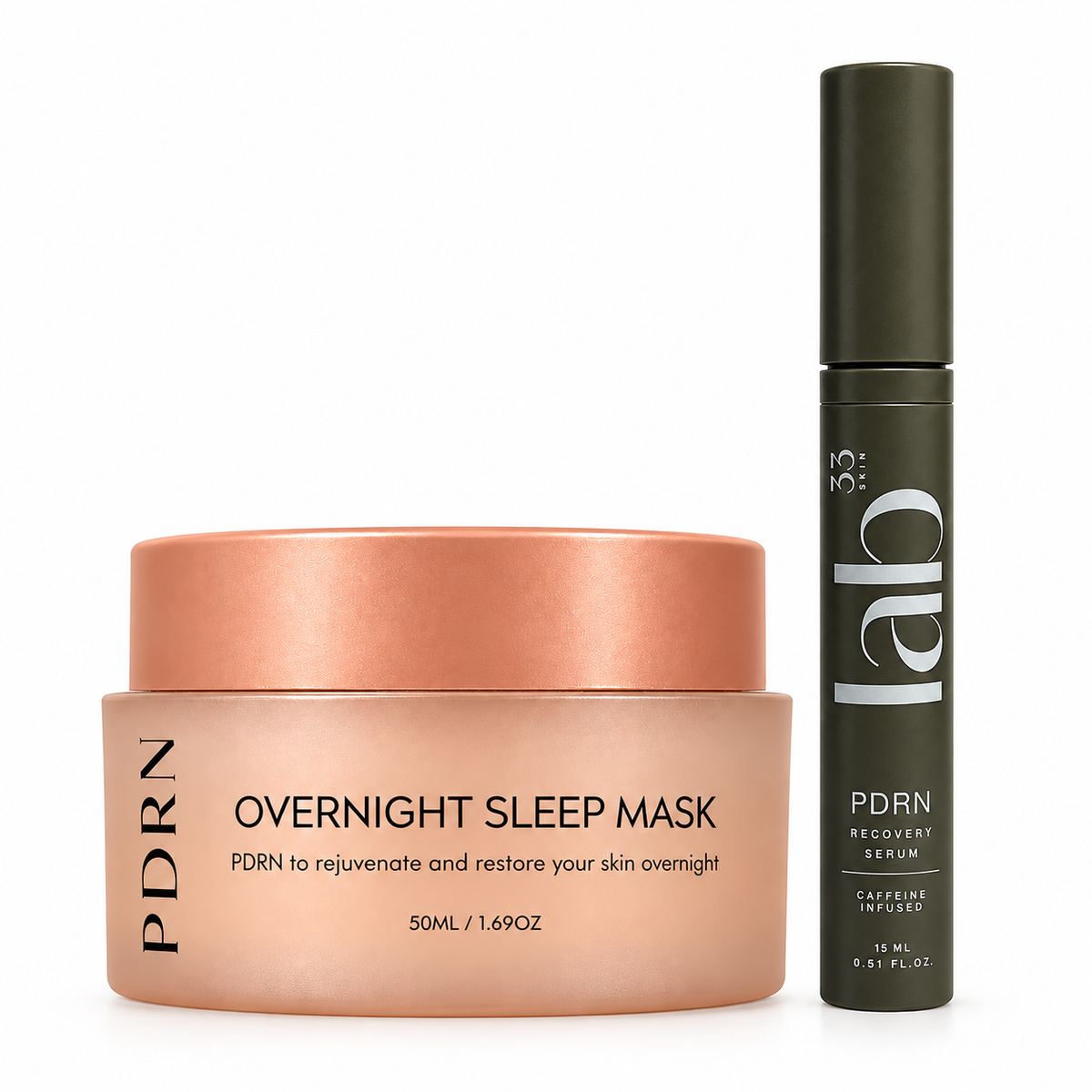
The PDRN in the LAB33 PDRN Recovery Serum and PDRN Overnight Sleep Mask is sourced from salmon.
Why is PDRN so popular in Korea?
PDRN first became known through medicine. For decades it has been studied for its role in supporting tissue repair, and in Korea it became a popular in-clinic treatment, often called a skin booster, used to help skin look healthier and more resilient.
As interest grew, Korean laboratories began formulating PDRN into everyday skincare, so people could include it in their routine at home rather than only in a clinic.
What does PDRN do for skin?
PDRN is valued in skincare for helping to support the skin's natural renewal and recovery. That is the honest way to describe it. Skin is constantly repairing and renewing itself, and PDRN is used to support that process rather than replace it.
It is worth being clear about the evidence. Much of the research on PDRN looks at it in clinical settings, such as injectable treatments and wound care. Research into PDRN in topical skincare is newer and still growing. That is why the best PDRN formulas pair it with well-established ingredients, so your routine is not relying on one ingredient alone.
What works well alongside PDRN?
PDRN is gentle and plays well with others. In LAB33 formulas it is combined with ingredients that have a long track record:
- Peptides, such as the 10-peptide complex in the PDRN Recovery Serum, to help skin look smoother.
- Niacinamide (vitamin B3), a well-researched all-rounder that helps reinforce the skin barrier and refine the look of texture and tone.
- Adenosine, a staple of Korean line care that helps soften the look of expression lines over time.
- Humectants such as polyglycerin-3 and glycerin, used in the PDRN Overnight Sleep Mask to draw in moisture and hold it overnight.
- Panthenol (pro-vitamin B5) to help soothe and support a comfortable, resilient barrier.
Is PDRN suitable for sensitive skin?
PDRN itself is generally considered gentle, and it is often used in barrier-first formulas. As with any new skincare, patch test before first use, and speak to a doctor or dermatologist if you have a skin condition or are unsure.
If you have a fish allergy, check with your doctor before using PDRN skincare sourced from salmon.
How to use PDRN in your routine
PDRN works best as part of a consistent routine. A simple way to start:
- Every morning and evening: apply a PDRN serum to the areas you care about most. The PDRN Recovery Serum has a cooling steel applicator for the forehead, between the brows, crow's feet, under the eyes, smile lines and above the top lip.
- Two nights a week: finish your evening routine with a PDRN mask. The PDRN Overnight Sleep Mask goes on as the last step and is rinsed off in the morning.
- Every morning: follow with moisturiser and sun protection.
If you want both, The PDRN Recovery Ritual brings the serum and mask together as one routine.
PDRN at a glance
- Full name: polydeoxyribonucleotide
- On the label: sodium DNA
- Usually sourced from: salmon
- Known for: supporting the skin's natural renewal and recovery
- Best used: consistently, alongside proven ingredients
Frequently asked questions
Is PDRN the same as polynucleotides?
They are closely related. Both are made of DNA fragments, but polynucleotides (often shortened to PN) are longer chains. Both are used in Korean skin boosters. We will cover the difference in more detail in a separate guide.
Is PDRN vegan?
No. Most PDRN in skincare, including ours, is sourced from salmon, so it is not vegan.
Can I use PDRN with retinol?
Yes, PDRN is generally easy to layer. If you use retinol, introduce new products one at a time and keep your routine simple while your skin adjusts.
How long does PDRN take to work?
Skin renews over a cycle of several weeks, so give any new routine at least that long, used consistently, before judging it.
This article is for general information and is not medical advice.

